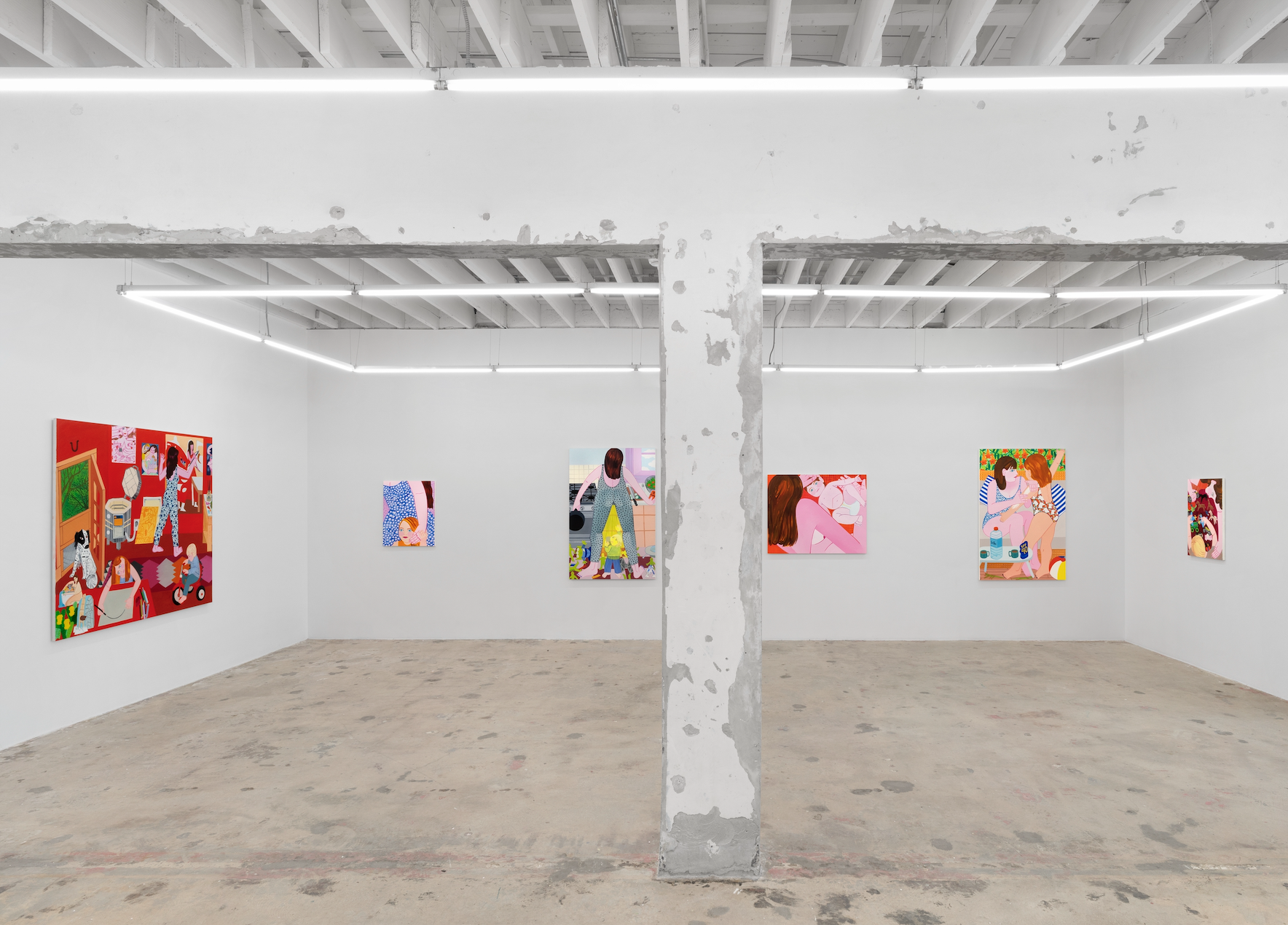
Madeline Donahue (b. 1983, Houston, TX) makes paintings, drawings and ceramics that center on her experiences of pregnancy, birth, motherhood and owning a postpartum body. Her practice focuses on the surreal reality, physicality, emotionality and interdependence of these experiences. Intimacy is at the core of all of her work, addressing the simultaneous existence of abject and sublime facets implicit in the relationship with her children and body. These explorations detail these experiences – working through the isolation, fatigue, failure, anxiety, and joys of parenting. In Donahue’s work, pendulous breasts flap, stretched belly skin sags or flows. Many of her works include “bathers” – a nude figure moving through water, referencing Modernist portrayals of bathing women. She also references gymnastics, sports, and the “circus” of motherhood through titles, in the posture of her figures, and other visual representations. Each work is made efficiently in a fresh and fluid process that communicates and captures the immediacy of a present moment to create art.
Madeline Donahue’s solo exhibitions include “Fun House” with Praise Shadows Gallery, Boston; “Warm Up” with Artshack Brooklyn, and “Attachments” with Steven Harvey Fine Art Projects in New York. She has participated in Untitled Art Fair and NADA Fair (Miami, FL) and exhibited extensively with galleries and museums across the US and UK including Johansson Projects (Oakland, CA), Lauren Powell Projects (Los Angeles, CA), Hesse Flatow (New York, NY), Deanna Evans Projects (Brooklyn, NY), and the Museum of Fine Arts (Boston, MA). Residencies include The Wassaic Project, Byrdcliffe Artist Colony, Artshack Ceramic Residency and Interlude Artist’s Residency in Livingston, NY. Donahue’s work has been reviewed in the Guardian, Hyperallergic, and Elephant Magazine. Interviews include Sound + Vision Podcast, I Like Your Work Podcast, and Artist Mother Podcast. She recently participated in “A Conversation on Alice Neel, Art, and Motherhood” facilitated by Lauren Palmor, assistant curator of American art at the Fine Arts Museums of San Francisco. Donahue holds a BFA from The School of the Museum of Fine Arts at Tufts University (Boston, MA) and MFA from Brooklyn College (Brooklyn, NY). Madeline Donahue lives and works in Brooklyn, NY.