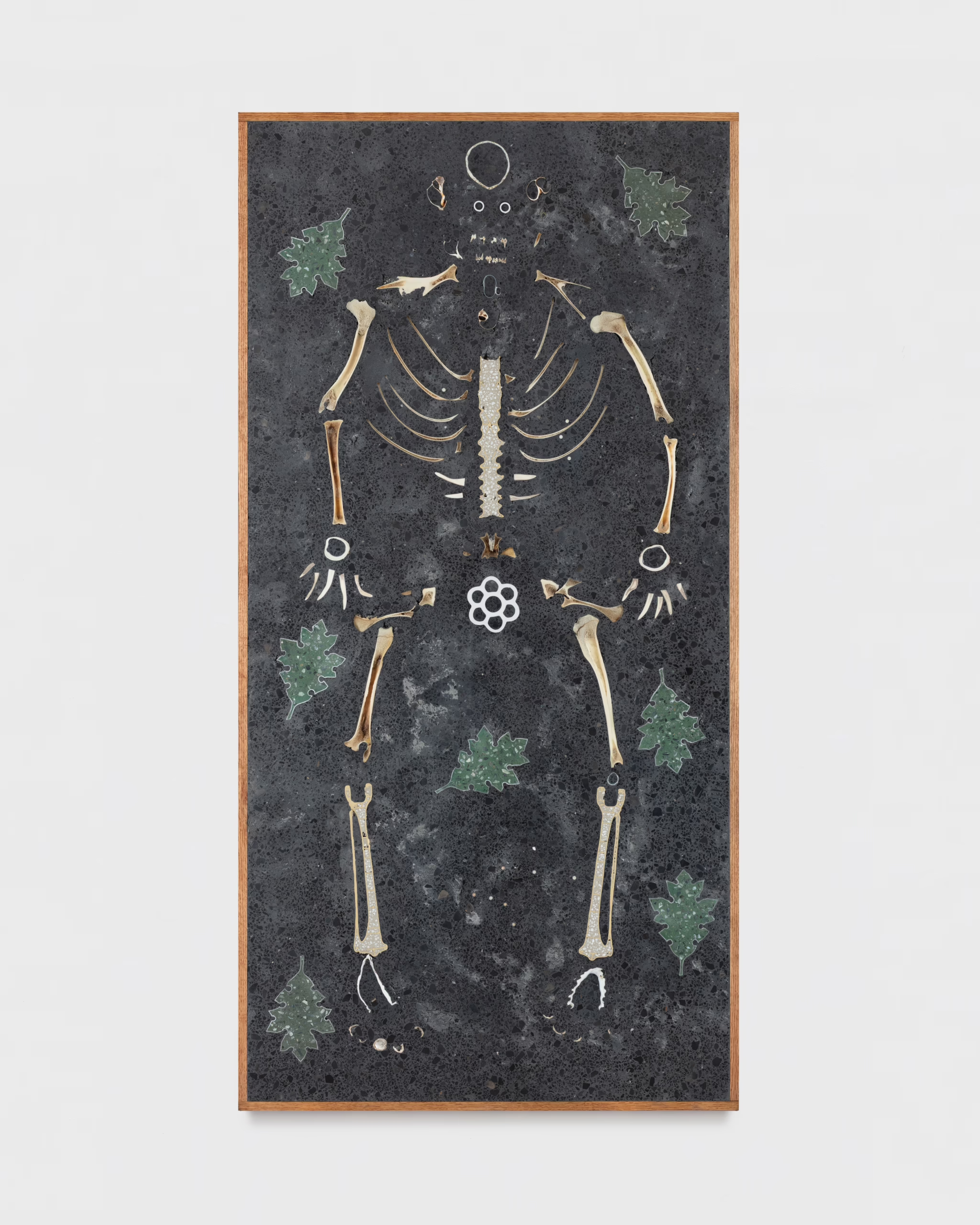
Nina Johnson is pleased to present a group exhibition inspired by the concept of a surrealist garden, shaped simultaneously by growth and decay. Conceived as an environment in which material and process unfold across a continuous spatial field, the booth will showcase new bodies of work by Ana Benaroya, Cooper Cox, Katelyn Eichwald, Balarama Heller, Ficus Interfaith, Estefania Puerta, and Anders Herwald Ruhwald.
The presentation will be anchored by a walkable, site-specific terrazzo floor by the artist duo Ficus Interfaith. Conceived as both an installation and a collection of individual inlaid panels, the floor depicts life-size human skeletons in burial repose alongside hand-bent metal foliage. Also embedded within the terrazzo are real river stones, oyster shells, and strands of salvaged pearls, creating a landscape that evokes both a garden and burial site. Drawing on archaeological traditions of “grave goods,” objects buried alongside the dead as possessions or markers of identity for the afterlife, Ficus Interfaith transforms these materials into traces of unknown lives, resulting in an installation that moves between ornamentation and mortality. Once removed from the booth installation, the works function as intricately detailed and textural wall pieces.
Ana Benaroya presents a new body of work that continues her engagement with the female nude through exaggerated musculature, saturated color, and theatrical compositions. Drawing from comic books, art history, and queer culture, Benaroya creates figures whose heightened gestures and emotional states blur the line between fantasy and self-portraiture. Across these works, bodies shift and transform as flesh dissolves into streaks of light and fractured color, bringing together desire and self-invention. Within the booth’s surrealist garden, Benaroya’s fantastical figures introduce the body as another mutable form, continually transforming within the surrounding landscape.
In three new oil paintings, Cooper Cox turns his attention to the tradition of floral still life. Much of Cox’s practice is rooted in landscape, memory, and the emotional experience of being in nature, approaching landscape as something psychological rather than purely physical. Beginning with experiences developed through digital tools, including AI, Cox then completely dismantles them through the process of painting. The works change as the viewer moves around them: from a distance, flowers and foliage come into focus, while up close they dissolve into color, gesture, texture, and abstraction. Cox transforms the familiar subject of the floral still life into something more subjective and atmospheric, shaped as much by perception and memory as by observation.
A group of new, intimately scaled paintings by Katelyn Eichwald turns familiar subjects toward the uncanny: a pink rose, a moth with translucent wings, sunburned thighs, and a black cat resting amid a sumptuous field of red fabric. Rendered with Eichwald’s characteristic restraint and close attention to surface, these fragments of bodies, nature, and domestic life hover between tenderness and unease. Their small scale draws the viewer into private encounters in which beauty is tinged with vulnerability, desire, and decay, transforming seemingly ordinary images into something more elusive and psychologically charged.
Balarama Heller presents new works that continue his exploration of the boundary between scientific observation and symbolic imagination. Activated by light and the position of the viewer, the works shift as they are encountered, producing images that hover between physical presence and optical phenomenon. Heller’s longstanding interest in the unseen considers how perception, belief, and imagination shape our understanding of what cannot be readily seen or understood. Continually changing according to the conditions in which they are viewed, both the holograms and the magnetic field works introduce an elusive, immaterial presence, complicating the distinction between what is physically present and what is perceived.
Estefania Puerta presents six new works that move between painting, sculpture, and installation. Constructed with aluminum leaf and inset stained glass, the works hold organic matter, minerals, shells, and bodily fragments alongside reliefs shaped into a swirling, abstracted language. The works consider objects as carriers of history and containers as fraught spaces for language and categorization. Held between preservation and transformation, their materials shift between the familiar and the not quite nameable, suggesting specimens, relics, and living matter in states of continual change.