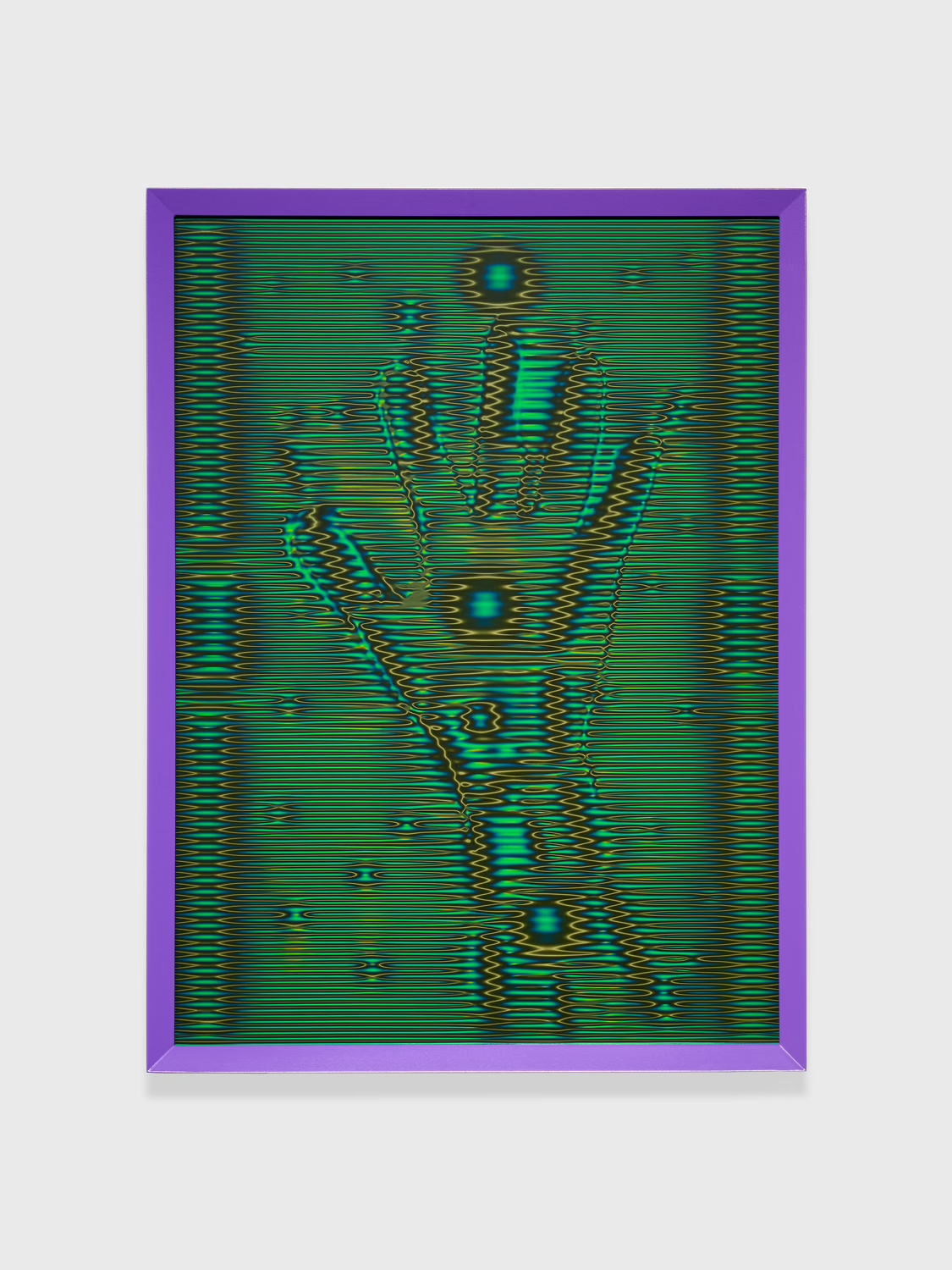
Nina Johnson presents The Void Which Binds, an exhibition of new multimedia works by Balarama Heller that brings into view unseen physical forces that structure the universe and sustain life on Earth. Working across sculpture and holography, Heller creates works rooted in scientific principles yet whose visual language evokes relics of unknown origin, exploring the human impulse to make sense of phenomena that exceed ordinary perception.
Throughout the exhibition, Heller harnesses magnetic fields and holography to generate shifting forms. The works inhabit an ambiguous territory between something measured and something encountered. What appears is never located in any one material or object alone. Instead, the image arises through relationships that remain active and contingent.
In a series of wall works he calls Flux Mirrors, Heller sculpts with magnetic fields. Arrangements of magnetic material shape and redirect otherwise invisible flux, translated into lambent fields of spectral color through a nanophotonic medium. The resulting images resemble luminous celestial bodies and radiant archetypal symbols, but their appearance is not fixed. Color and form change according to the configuration of the field, light, and the viewer’s position. The image belongs neither entirely to the magnetic source nor to the material through which it becomes visible, but to the interaction between them.
In an adjoining space, Heller presents Invocation Entities, a sculptural installation, combining holography with lava-like forms. Holographic pictograms float within the dark interior of the sculpture, hovering between material presence and optical apparition. The work brings together two radically different registers of matter and time: the primordial nature of lava and the nearly immaterial presence of holographic light.
The sculpture also draws upon the capacity of naturally occurring volcanic material to preserve traces of Earth’s magnetic history. As molten rock cools, magnetic minerals can align with the geomagnetic field and retain that orientation, creating a paleomagnetic record of changes and reversals in Earth’s field across geological time. Generated by motion within the planet’s liquid outer core, this same invisible field extends far into space, shielding Earth from charged solar winds, creating conditions essential to life. Here, stone becomes a carrier of invisible information alongside the hologram, whose image likewise emerges through a precise relationship between stored information, illumination, space, and observer. One points toward the deep memory of the Earth; the other produces an image that appears to exist without physical substance.
This emphasis on relation runs throughout The Void Which Binds. A magnetic field becomes perceptible through its effect on matter. A holographic image appears only under particular conditions of light and position. The viewer becomes one of the variables through which the work takes form. Heller is interested in the possibility that phenomena may not reside entirely within individual things, but emerge in the intervals and interactions between them.
Heller’s interest in the unseen is rooted partly in his upbringing. Born in Friendship, New York, and raised in Hare Krishna communities across the United States, he grew up immersed in Hindu cosmology, New Age thought, and spiritual inquiry. These experiences continue to shape his interest in how people construct meaning around phenomena that resist immediate perception or understanding. His practice approaches these questions through measurable physical processes while remaining open to the symbolic imagination they provoke. Scientific observation and mythic thinking become distinct responses to an encounter with the unknown.
Across The Void Which Binds, scientific instruments can resemble relics and physical events can acquire the character of apparitions. Heller’s works suggest that greater knowledge of the mechanisms of the world need not diminish its mystery. Instead, observation can reveal the strangeness already embedded within familiar reality. The works do not propose another world so much as alter the conditions under which this one becomes perceptible.