Earth Craft: Germane Barnes and Vyta Pivo to curate U.S. Pavilion at Biennale Architettura 2027
By Daniel Jonas Roche
The Department of State announced today the University of Miami School of Architecture (UM) will represent the U.S. in Venice at the Biennale Architettura 2027. The university’s installation for the U.S. Pavilion is titled Earth Craft.
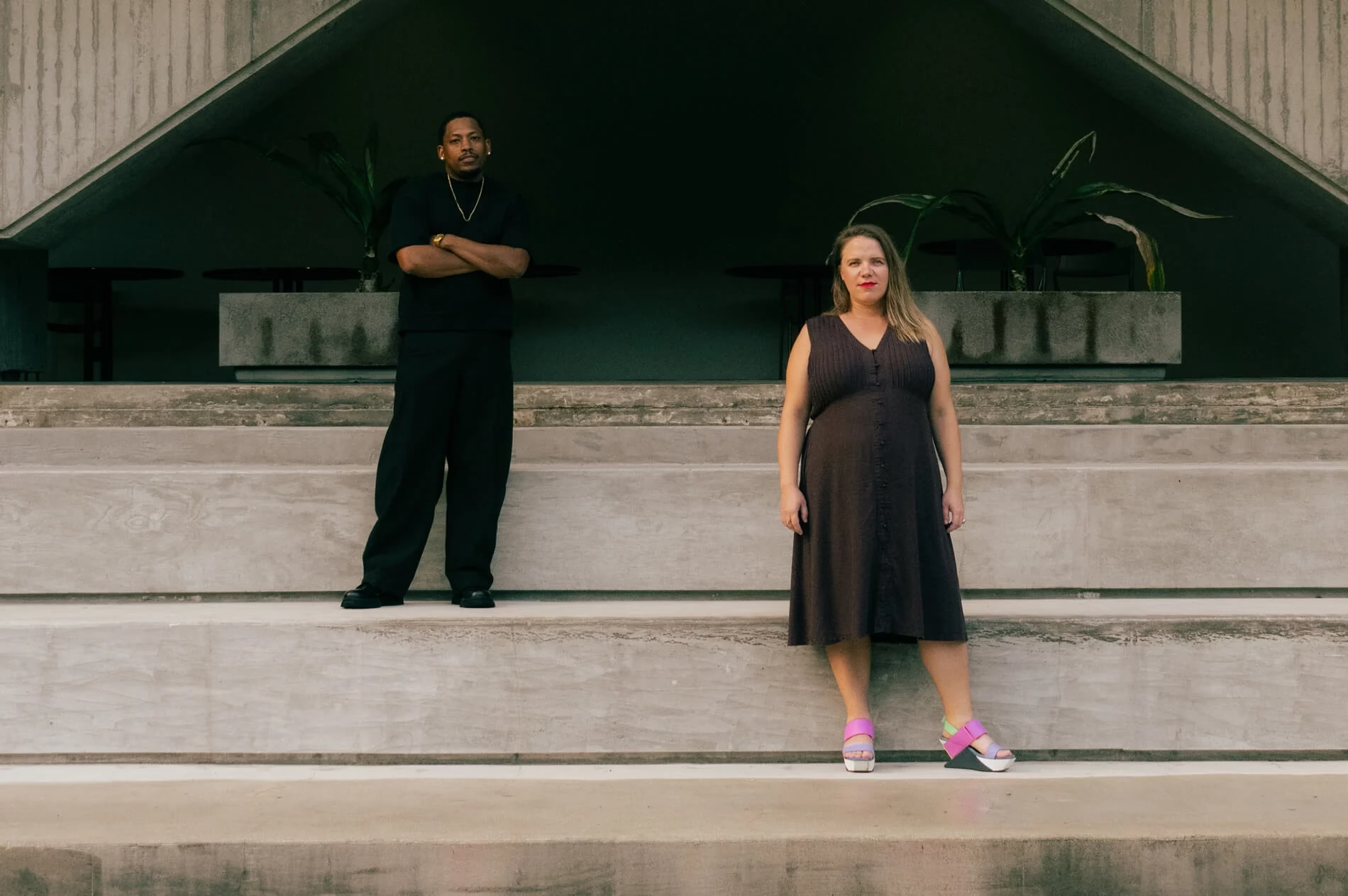
Germane Barnes, UM associate professor and founder of Studio Barnes, will serve as lead curator of the U.S. Pavilion. Barnes will collaborate with Vyta Pivo, UM assistant professor of architectural history and theory.
Five Rooms, Five Themes
Barnes’s work will be on view within the U.S. Pavilion. The curators will show other architects and designers, including Nader Tehrani of NADAAA, architect and UM professor Carie Penebad, and UM School of Architecture dean Rodolphe el-Khoury.
Leah Wulfman, a multidisciplinary designer and professor at University of Tennessee, Knoxville, will be a featured designer. Also, the work of Merritt Chase, a landscape and urban design firm based in Indianapolis and Pittsburgh, will be on view. (Merritt Chase won a 2025 Best of Practice Award from AN.)
UM professor Maxwell Jarosz will design an exterior courtyard installation with UM students. “You’ll see in the courtyard different types of modular pieces made of different earthen materials. You’ll see physical remnants of marble, of limestone, of clay, etcetera,” Barnes noted.
The U.S. Pavilion has five rooms, or salons, including the rotunda. Each of the participants will have space to show their work, but they are also “responsible for keeping this larger narrative together, so they’re all connected,” Barnes said.
The first room is the “excavation room,” or the “earth room,” and will be curated by Merritt Chase. The second room will be the “labor room” curated by Studio Barnes. The third room will be dedicated to “speculation” and curated by Wulfman.
The fourth room is dedicated to “fabrication” and curated by Tehrani and el-Khoury. (The pair cofounded Office dA in 1986, which Mónica Ponce de León joined, but later branched off.) The fifth room, by Cure + Penabad, is dedicated to “preservation.”
Barnes emphasized it’s important that “a person walking through the sequence doesn’t realize different people did the work in each of the rooms. We’re trying to tell a story in a cohesive way.”
“A Second Cut”
Barnes and Pivo will use materials to create “a section cut” of the country, Barnes said. The goal is to “tell a holistic story, as opposed to an individual story.” The pavilion will have its own “earthen materials library” and host fabrication workshops. A published catalog will accompany the exhibition.
Which materials? The exhibition will examine “adobe, rammed earth, limestone from the Midwest, red brick from the South, places like St. Louis or Tuskegee,” Barnes affirmed.
Extrapolating further, Pivo said in a statement the goal is to “honor the brick masons, workers, and tradespeople whose labor built this country and rarely get credited for it.”
“Their knowledge of soil, water, and heat is not a relic,” Pivo continued, “and we are putting it in the same building as robotic fabrication and computational design, because the new tools work best when they learn from the hands that came first.”
The Curators
Today Barnes directs the master’s of architecture program at UM. He is also a founding member of Black Reconstruction College; Barnes was one of 11 participants included in MoMA’s 2021 exhibition Reconstructions: Architecture and Blackness in America.
In 2021 Barnes won Harvard GSD’s Wheelwright Prize and the Architectural League Prize for Young Architects and Designers. That year, he also exhibited in the Chicago Architecture Biennial.
Between 2021–22 Barnes was a Rome Prize Fellow in Architecture. In 2023 Barnes displayed Griot at the Venice Architecture Biennale. That year he also completed a memorial to Emmett Till and Mamie Till-Mobley in Chicago, his hometown.
In 2025 Barnes displayed Joy Riding at Exhibit Columbus, and was a Miller Prize recipient. That year he also showed Columnar Disorder at the Art Institute of Chicago.
Barnes has works in the permanent collections of LACMA, the San Francisco Museum of Modern Art, and the Art of Institute of Chicago. Studio Barnes is currently redesigning a former “klavern” in Fort Worth, Texas, into a community center.
Pivo’s scholarship centers material lifecycles, construction labor, ordinary landscapes, and climate change. Her forthcoming book is titled Cast in Concrete: How the U.S. Built Its Empire (University of Chicago Press) which will trace the evolution of the U.S. cement and concrete industries as planetary forces.
To date Pivo’s research has been featured in Architectural Theory Review, Journal of the Society of Architectural Historians, Journal of Architectural Education, PLATFORM, Psyche/Aeon, and other outlets.
Pivo has received research support from the National Science Foundation, Andrew Mellon Foundation, American Council of Learned Societies, the Smithsonian Institution, Library of Congress, Michigan Society of Fellows, and the MacDowell Fellowship.
Barnes thanked el-Khoury for giving him his blessing to pursue the project. El-Khoury elaborated in a statement:
“As an American school of architecture, we study the full range of what this country has built, and that includes the work of the people who built it—not just the designers whose names are bolded in textbooks, but the unrecognized field leaders innovating in materiality and craft that enabled the building techniques that define America. Representing the United States in Venice is an incredible opportunity to bring this perspective on American architecture to an international audience, and we are grateful for this opportunity.”