HOW IT IS THORSTEN SCHNEIDER ON ROCHELLE FEINSTEIN AT THE LUDWIG FORUM, AACHEN
With the exhibition “You Again,” which ran simultaneously in six different galleries in North America and Europe in 2018, Rochelle Feinstein made a joke at her own expense: As so often in her oeuvre, she cited forms and styles from the history of painting and from her own work of the past 40 years. The title of Feinstein’s current exhibition, “The Today Show,” which is now on view in Aachen after stops in Vienna and Glarus, also plays with the expectations and experiences of the viewer. In his review of the exhibition, Thorsten Schneider argues that Feinstein’s repetition of the formal crisis of painting can be understood as a form of representation for contemporary crises that does not dissolve into abstraction or representation.
“As is” – this phrase is used in retail jargon to indicate the exclusion of warranty. The buyer agrees to accept the offered goods “as is,” accepting any defects discovered later. Rochelle Feinstein used this common term to reflect on abstraction in painting in her lecture “AS IS: Abstraction as Resemblance,” which she gave in 1998 at the 86th College Art Association in Toronto. With the title, she alluded to a phenomenological approach to art that recognizes only that which is familiar. However, this would fail to understand the broader contexts of artistic, historical, and social discourses through which art acquires its meaning in the first place. Feinstein speaks out against a reception attitude that reduces art to its appearance as form. At the same time, she opposes a realism that commits art to the representation of the world and, in doing so, overlooks the artistic means of that representation.
The title of Feinstein’s current exhibition at the Ludwig Forum, “The Today Show,” is a reference to the popular NBC news program “Today.” This suggests topicality and a connection to the political events in the artist’s home country. However, this expectation falls flat for Feinstein, whose works neither depict nor directly comment on current conditions. Her engagement with the contemporary conditions and possibilities of painting is simultaneously a painterly engagement with her own contemporaries, one that extends far beyond artistic self-reflection, yet is always aware of its limited social resources as art. “Crisis as form,” [1] in the sense of Peter Osborne, is not presented as a new form of crisis, but rather in the almost stoic work on outdated, used forms that are clung to. Osborne’s central thesis is that contemporary art can best respond to social and political crises by reflecting on its own formal crisis.
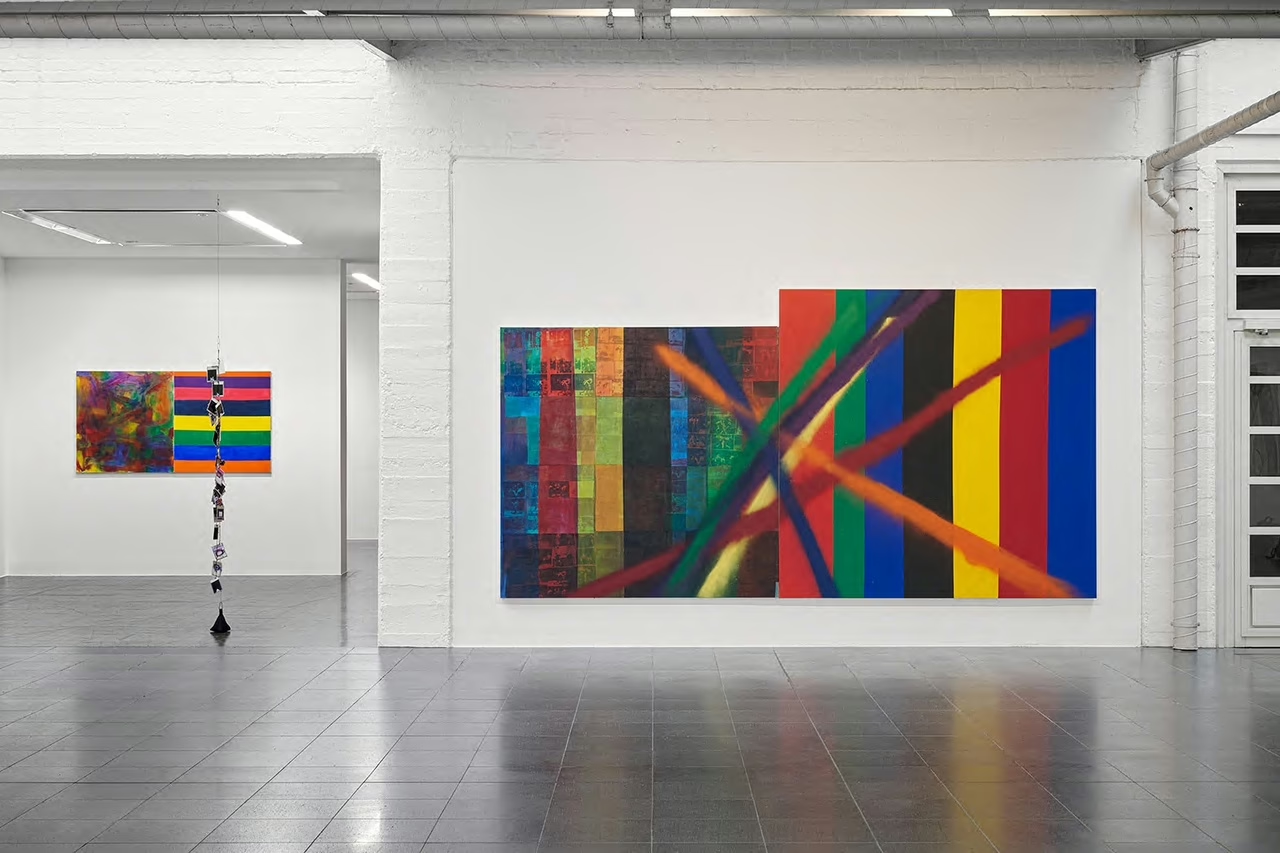
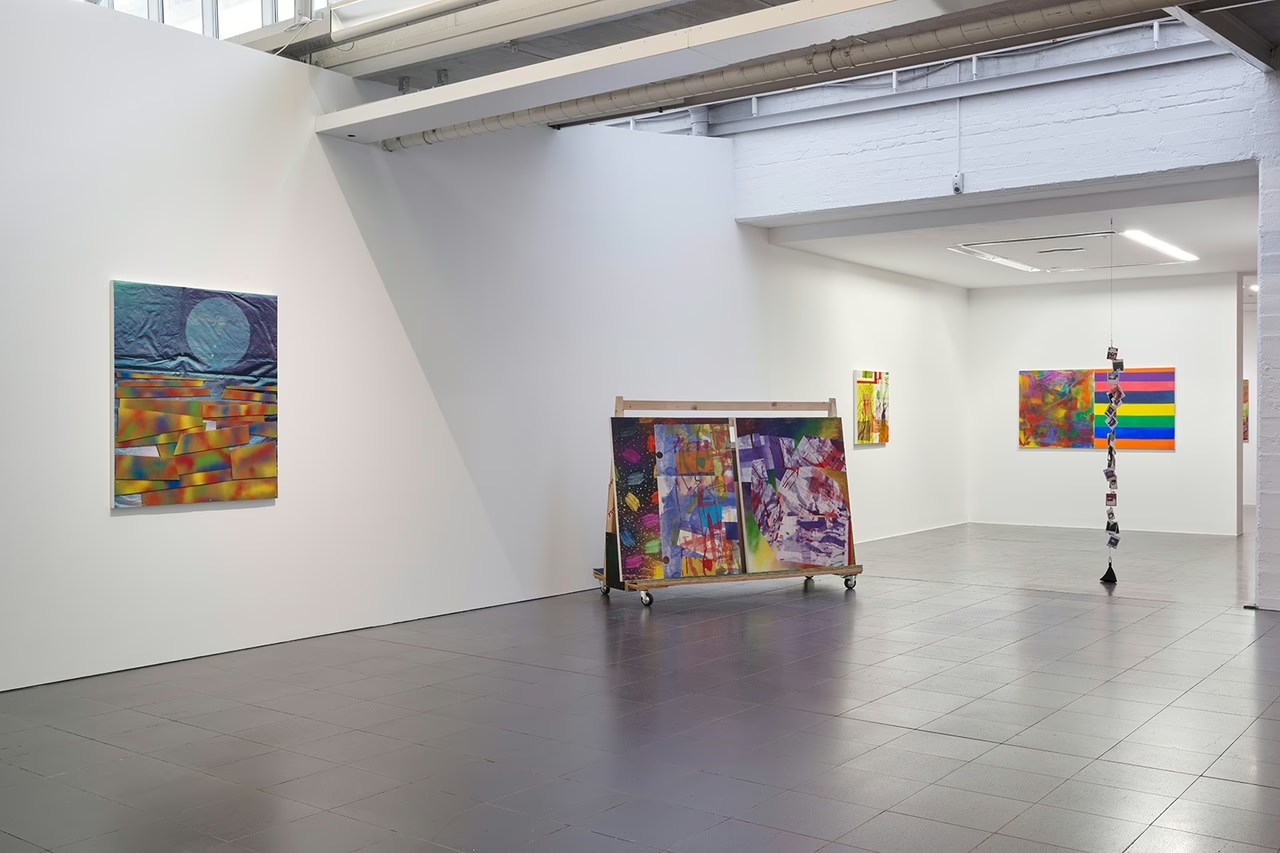
In “The Today Show,” this reflection on the formal crisis is evident in the uncanny similarity to established museum forms of presenting painting, as they have become established since post-war modernism. Without challenging established conventions through aggressive experimentation, the hanging meets all expectations of a contemporary presentation of painting. While at the Vienna Secession and the Kunsthaus Glarus, where the exhibition was previously shown, all the works could be grasped at a glance, in Aachen the context of the exhibited works only becomes apparent after walking through several rooms. The linear course reveals fascinating connections that only gradually emerge, as they are meant to be remembered and established through reflection and are not immediately accessible to a phenomenological art appreciation. In the first room, the diptych Tagged (2019) makes no secret of its debt to Pop Art, or more precisely, to the works of Robert Rauschenberg. Black-and-white photographs of boxing matches from the Italian fascist era—as the accompanying booklet reveals—run like a film strip across the left canvas, painted over with the rainbow colors characteristic of Feinstein’s work since 2016 (the year before Donald Trump’s first presidency), which continue as opaque bands of color on the right canvas. Both halves of the image are literally crossed by diagonal lines gesturally applied with spray paint. The photographed scenes of the boxing match can be understood as a representation of the political struggle, closely linked to the abstract representation of color. Drawing on Osborne, the conflict between the artistic representation of social and political crises and the inherent formal crisis of contemporary painting can be recognized.
In the context of the exhibition title, the question arises as to the extent to which the historical political struggles evoked can also be helpful in understanding the current threat posed by reactionary and right-wing forces, which, with Alberto Toscano, can be described as the political formation of “Late Fascism” [2] . With regard to the representational options of Feinstein’s paintings, however, it also remains to ask what is particularly contemporary about them. Doesn’t the current crisis, in politics and society as well as in art, essentially consist in the fact that most of the offered answers to the existing problems of the time are unsatisfactory? What fundamentally characterizes Feinstein’s artistic work is precisely this question itself. Kerstin Stakemeier aptly calls this “Rochelle Feinstein’s school of bad options” [3] .
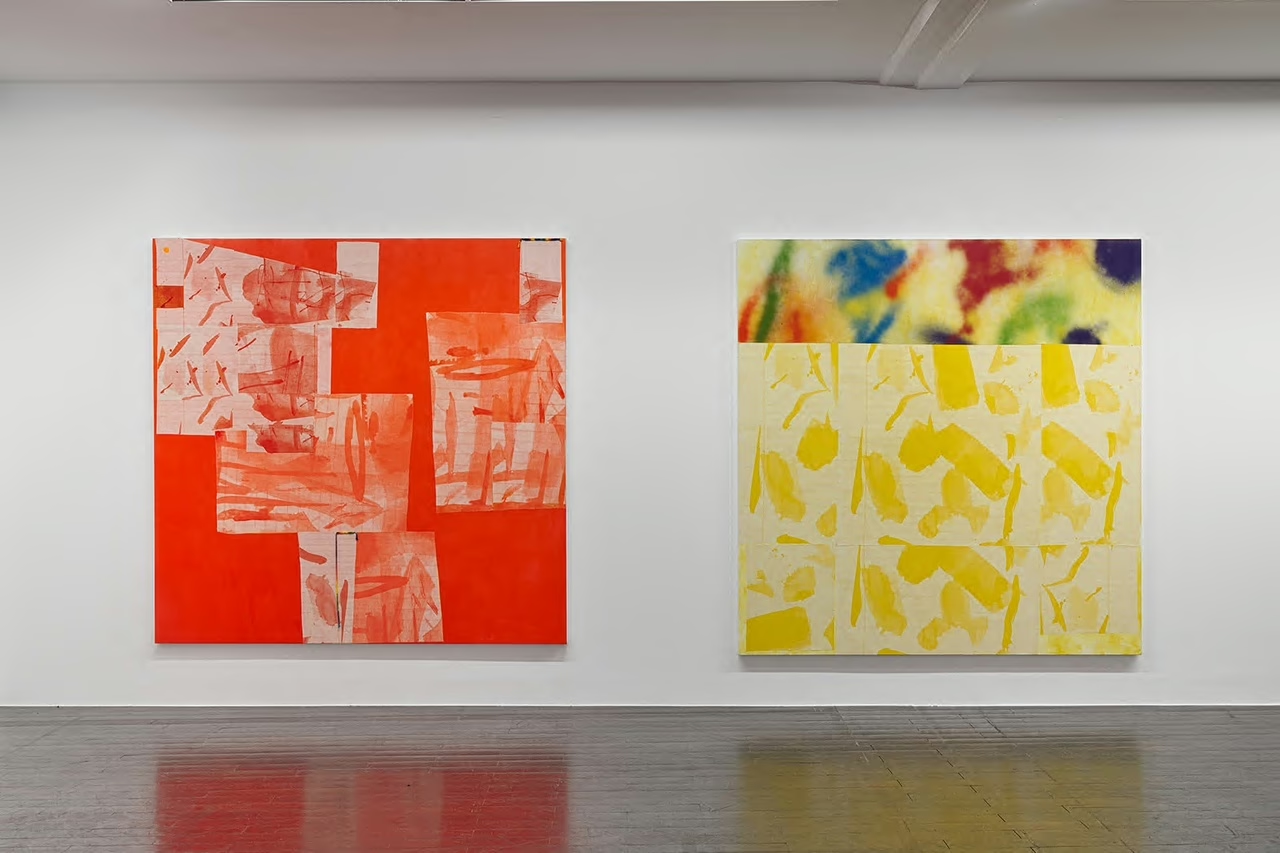
Opposite the diptych is a series of collages that Feinstein names Memory Holes (2023–24) after George Orwell’s novel 1984. In literary terms, this refers to gaps in memory through which history is rewritten in a totalitarian social system. In Feinstein’s work, the critique of authoritarian historical falsification is formally presented as a bad option in close artistic contact. The reworking of her own earlier, cut-up, and reassembled works becomes an artistic palimpsest. Specifically, this results in collages made of various crumpled fabrics, canvases, or cardboard, and fragments of older prints, brought together in a new image format. Their imperfect appearance clearly bears the traces of wear and tear from the painting process in the studio. Feinstein’s art can be understood as a form of recycling or the utilization of leftovers. She makes something of the material she finds both in the everyday images of her time and in the historical abundance of painting discourse. Film posters, fabric samples, scraps of paper, traces of paint, photographs, art-historical references, and all manner of gleaned and preserved items serve as her repository. Everything appears equally significant; distinctions between high and mass culture play no role – entirely unpretentious, without displaying any particular expert knowledge or an enlightening-didactic gesture. The artist does not stop at her own works, questioning the temporal order of a linear work’s genesis just as she negotiates current discourses on painting in the materiality of her works. In this way, she undermines the claim to invent a new form as well as the claim to originality or uniqueness. Instead of a break or an emphasis on the new, there is the painter’s ongoing engagement with the existing – the legacy of painting.
The reference to Lee Krasner’s series of collages entitled Eleven Ways to Use the Word to See (1976/77) underscores this aspect of Feinstein’s practice. Krasner, too, deconstructed her own older works in these works. Both artists also share a keen sense of titles. In her series Grammars (2024), on view in the main room of the exhibition, Feinstein associatively picks up Krasner’s titles that refer to grammatical tenses and rigorously declines them: Present Indicative (LK) (2024) – LK stands for Lee Krasner – Present Imperative (2024), Present Perfect (2024), or simply Simple Present (2024). In serial repetition, individual painterly elements are played out in various media and forms of reproduction. Recognizing where manual, painterly gestures are visible and where printmaking is particularly challenging the viewer’s powers of discrimination. As with Memory Holes, this work is about sifting through existing material, cutting it up, and reassembling it. By declining tenses, the specificity of time is undermined: The historical references and current political allusions suggested by the exhibition title merge in Feinstein’s painting into artistic material over which she freely disposes. Already in her 2022 exhibition “You Again,” which she showed simultaneously in six galleries in Paris and Zurich, twice in New York, in Miami, and Los Angeles, the artist played with time by satirizing the idealized notion of uniqueness in art through simultaneity and repetition.
The similarities and differences of painterly gestures, color gradients, and patterns that unfold in the Aachen exhibition across the boundaries of canvas and tape-framed murals play, in their combinatory nature, with questions of abstraction, flatness, form and formlessness, and grids. The assembled palette of painterly self-reflection is invoked. Conventions of abstract, gestural painting are demonstrated in order to undermine them and render them void. Motifs are duplicated, repeated multiple times, presented in multiple variations, and their form is repeatedly altered. Thus, every form of representation in artistic representation is negated, as is the notion of a painterly original. The diptych Two Maps (2024) fits perfectly into the spatial structure through the arrangement of color patterns and gestural pictorial elements, but at the same time is an art-historical reference to Jasper Johns’ Two Maps (1965). The question “Is It a Flag, or Is It a Painting?” [4] However, it sticks in one’s throat. Doubts arise as to whether what was previously recognized as abstract forms or painterly gestures can also be seen as a map or diagram of the political majority relationships in the US elections. The actual election results are usually not revealed directly, but rather mediated through a grueling process of political representation.
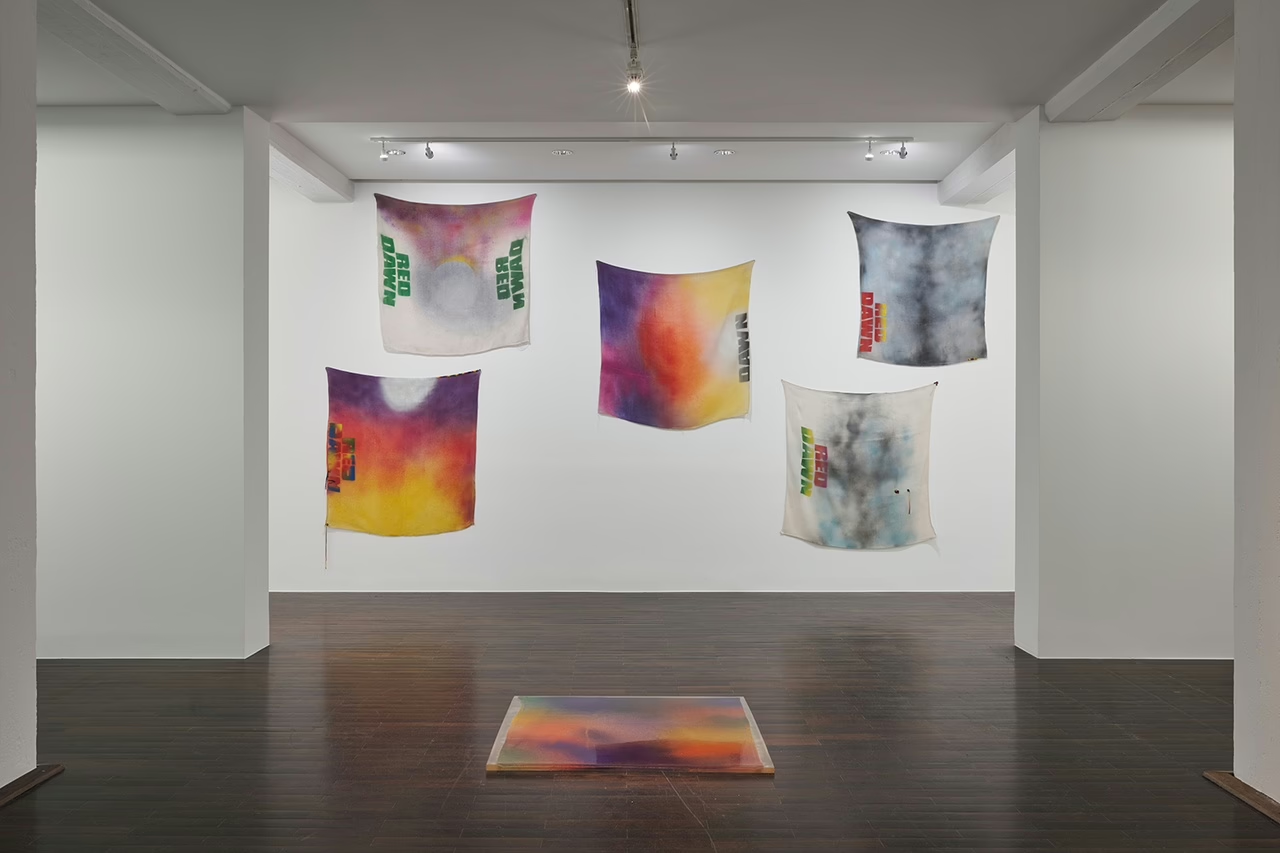
Given the current political context, Feinstein’s “Dawns” series, which she has been creating since the 1980s, appears almost dystopian. On cotton fabrics resembling studio rags, clinging to excess spray paint, blobs, and dirt, the words “Dawn” or “Red Dawn” are inscribed. This is a reference to a 1984 B-movie and its 2012 remake. The plot revolves around the invasion of the USA by Soviet, Cuban, and Nicaraguan troops during a fictional Third World War. In the 2012 version, the United States is attacked by North Korea. The friend-enemy pattern remains the same. Her “Dawns” are markers for her, the artist explains in the booklet accompanying the Aachen exhibition, chronicles of the late 20th and early 21st centuries—her lifetime. It’s striking how these works, over the course of years, are repeatedly caught up in the events of the present. The dawn promised by the series’ title is trapped in an endless loop, continually postponing hopes for a new day.
“Dawns,” like other works by Feinstein, laconically reference the artist’s studio practice. At the same time, however, they also function like genealogical litmus tests, which, however, do not reveal the specificity of the respective present, but rather the recurring form of a hollowed-out standstill. As if something clings to these works that eludes the references of painting discourse as much as it does a critique of the political present. Feinstein’s paintings are not history paintings, yet they convey an indeterminate, anachronistic feeling that all the more aptly captures the unease of the present. The works make painfully clear that there is currently little left to do but persevere, look at everything again, work through it, and move on. Whether this is the best option for responding artistically to social and political crises, as Osborne suggests, or, with Stakemeier, a poor option that makes a virtue out of necessity, remains to be seen. It therefore seems more than fitting that the exhibition tour ends in a dead end, allowing visitors to encounter each artistic work a second time upon exiting. Back and forth, taking another look to see what it’s like.
“Rochelle Feinstein: The Today Show,” Ludwig Forum Aachen, July 11 to December 14, 2025.
Thorsten Schneider is an art historian and critic. He is currently working as a postdoc in the Collaborative Research Center “Intervening Arts” at Leuphana University Lüneburg.
Image credits: Courtesy Ludwig Forum Aachen, Photos Mareike Tocha
NOTES
[1]Peter Osborne, Crisis as Form , London 2022.
[2]Alberto Toscano, Late Fascism , London 2023.
[3]Kerstin Stakemeier, “Bad Options for Everyone,” in: Rochelle Feinstein. The Today Show , exhibition catalogue, Secession Vienna, 2025, Cologne 2025, pp. 22–25.
[4]See Max Imdahl, “On the Possible Consequences of Concrete Art” [1969], in: Ders., Collected Writings , Vol. 1, On Modern Art , edited by Angeli Janhsen-Vukićević, Frankfurt/M. 1996, pp. 131–179.