MINJAE KIM AND DOMINIK TARABAŃKSI: The Brooklyn Neighbors Talk Friendship, FOMO, and Florals

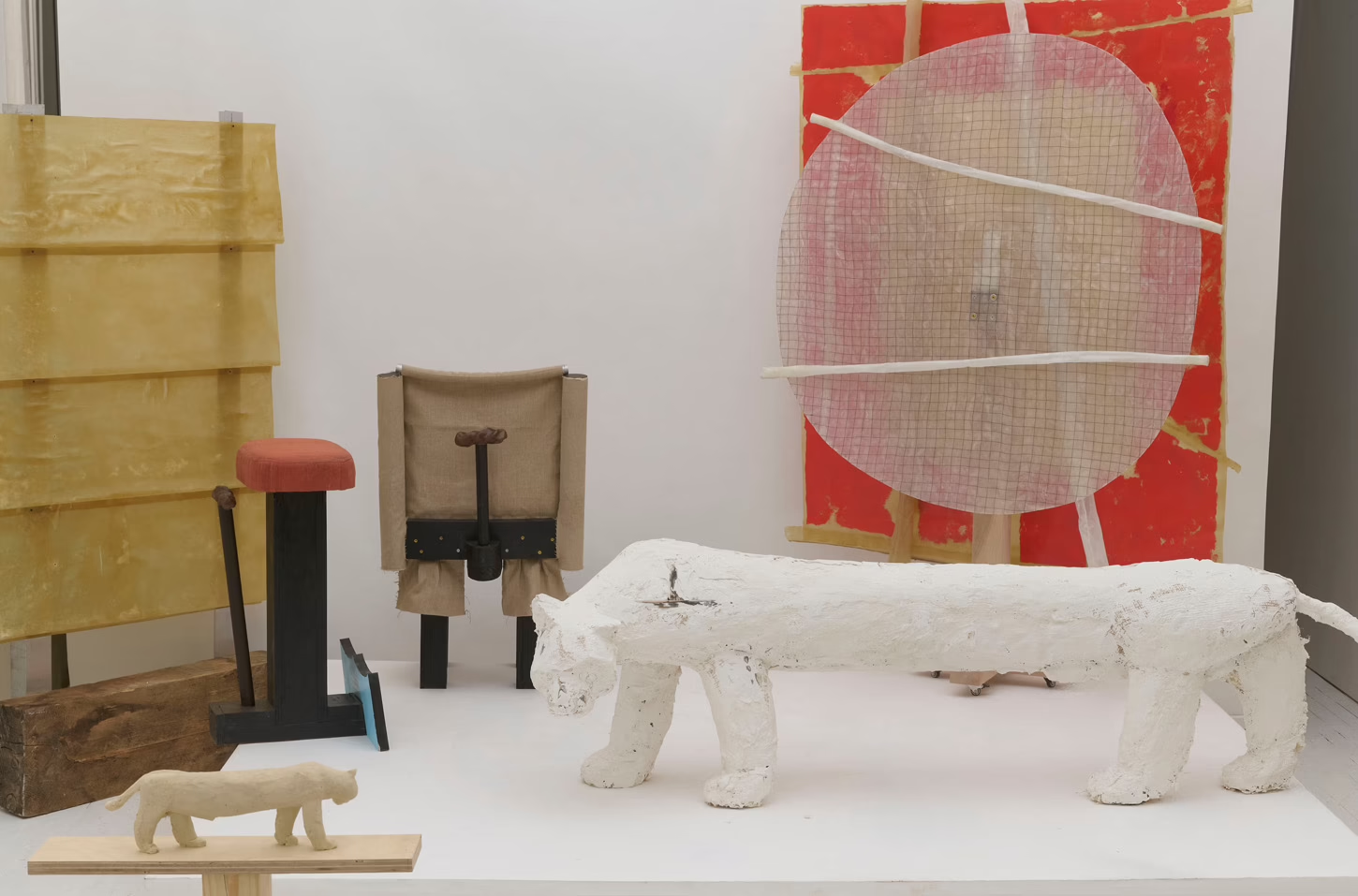
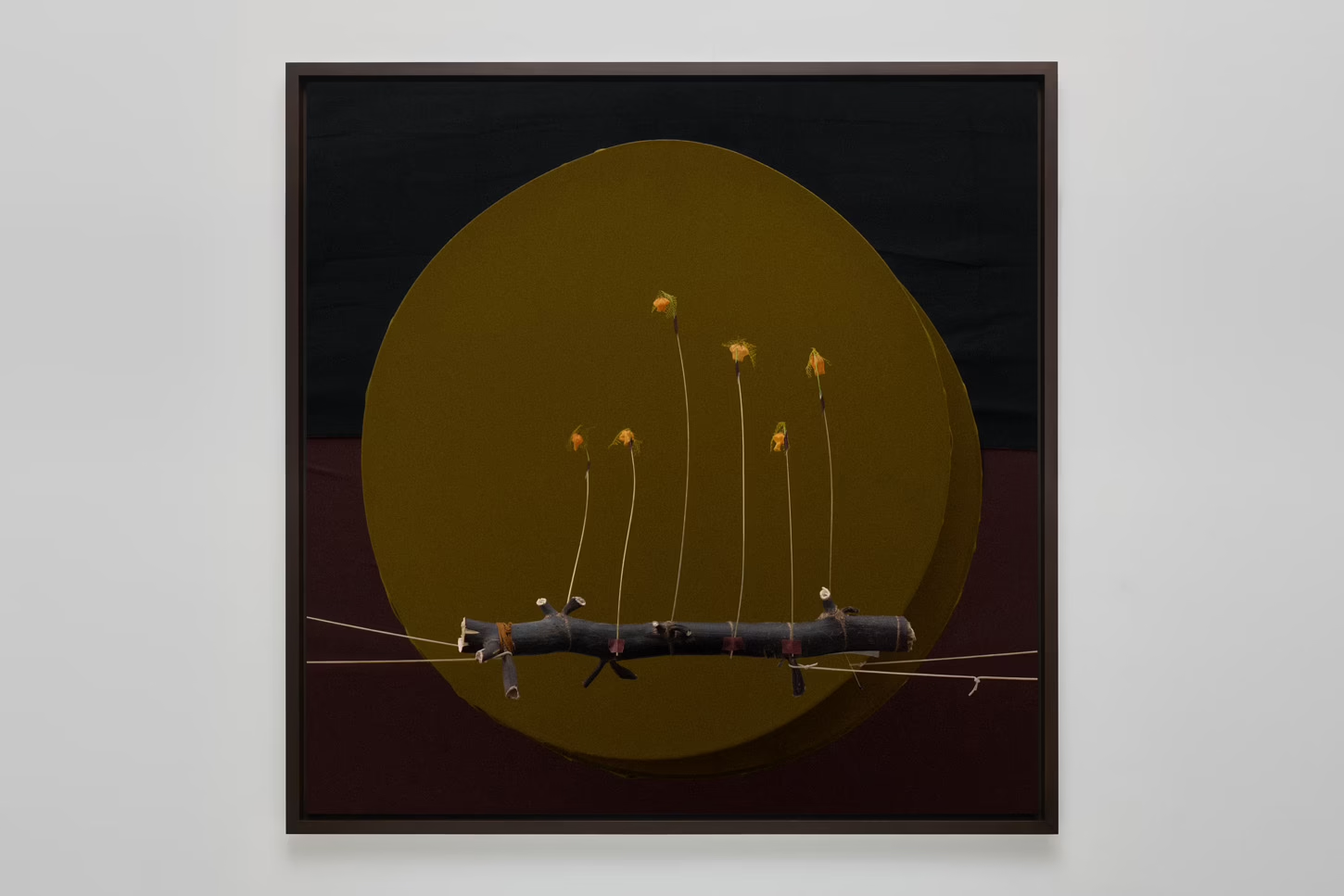
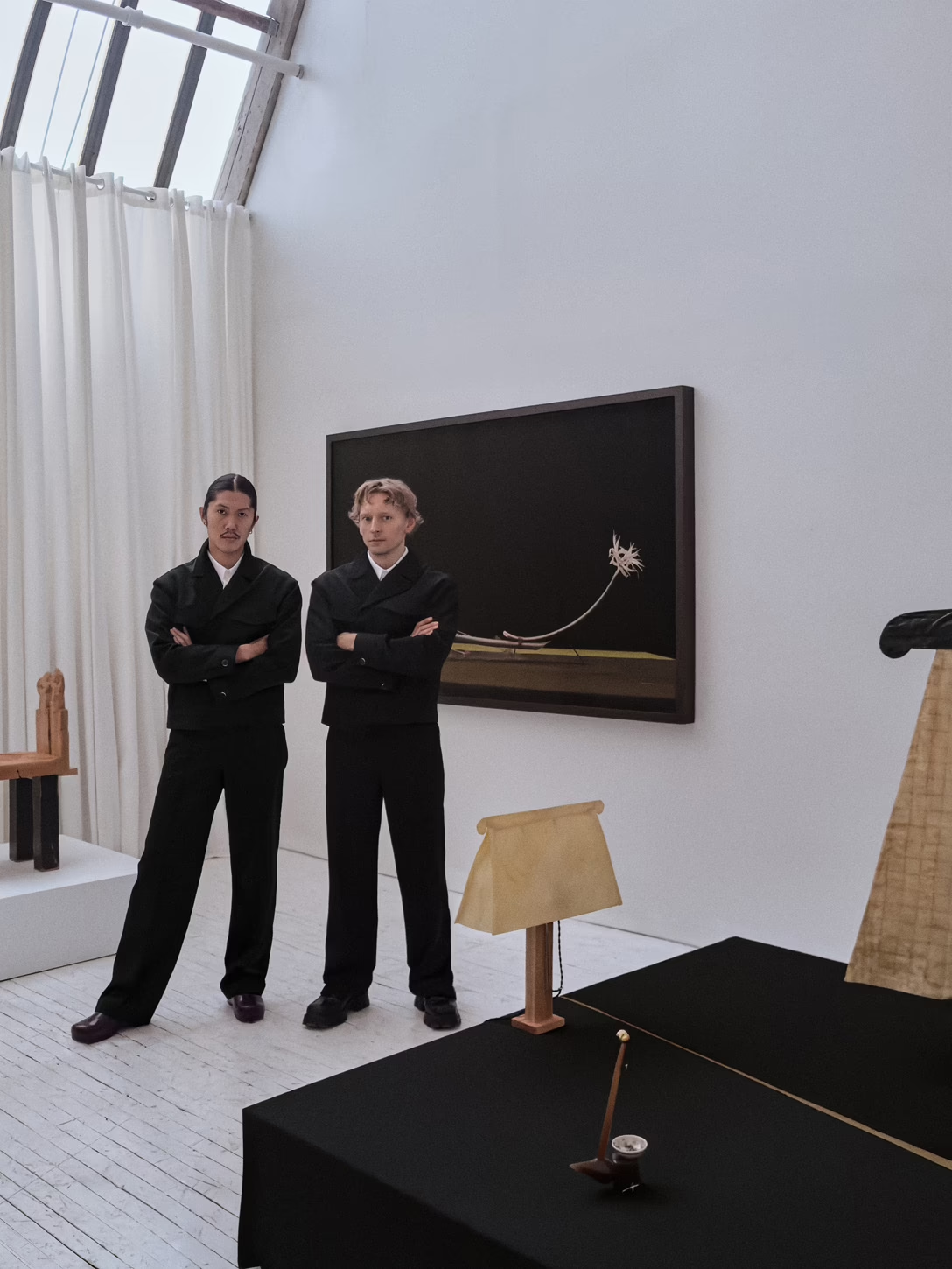
Minjae Kim and Dominik Tarabański are neighbors in their Brooklyn studio building. They are also friends, their rapport shaped as much by workouts and dinners as by studio visits and exhibitions. Though their practices are very different, Korea-born Kim’s hand-hewn, craftily nonchalant objects belie his background as an architect, while Polish-born photographer Tarabański is best known for his studied floral still lifes. Their collaboration has become something like a double act: the cinematic trope of two “sometimes combustible” protagonists coming together for a mission or trip. With casual self-awareness, they even named a recent joint show with Marta gallery Double Act. Their official collaboration didn’t come out of nowhere: it grew naturally out of their friendship and earlier, smaller exchanges, including Tarabański’s 2025 WSA presentation Roses for Mother, curated by Karen Wong, which featured Kim’s benches as a key design element. Each artist has, in some sense, turned his training against itself, becoming more intimate with his medium in the process. Kim studied architecture at Columbia GSAPP but, frustrated by the field’s time constraints, turned instead to objects. His hand-hewn furnishings retain architecture’s preoccupation with structure and scale, while circulating between collectible design galleries such as The Future Perfect and Nina Johnson, institutions like the Denver Art Museum, and, most recently, Oberon, the restaurant inside OMA’s New Museum expansion. Tarabański’s painterly floral still lifes are often autobiographical, built from the afterlife of more commercial shoots: flowers, plastic bags, clips, gaffer tape, zip ties. Since 2018, he has turned these remnants into intricate studio tableaux that are like sculptural worlds composed into two-dimensional images. The work has been exhibited across the U.S. and Europe, including at the National Philharmonic Hall in Szczecin, Poland, and the Centre for Contemporary Art Zitadelle Spandau in Berlin. Kim and Tarabański’s personalities may be as different as their practices, but in defining a series of key terms for PIN–UP, the logic of their friendship and their shared way of looking at the world comes into focus.
FRIENDSHIP
Minjae Kim: There are a lot of people who come to New York alone, without family. You build your world through friendship. Dominik and I have always shared that idea. Our friendship has opened a lot of doors in ways both big and small. He’s very generous. Like this morning, he picked me up so I didn’t have to ride my bike in the snow. Or he leaves little donuts at the studio.
Dominik Tarabański: I have many different types of friendships with different friends, but they all have this foundation: I can rely on them and trust them in a very open sense. I very quickly discovered in my friendship with Minjae that I could feel really comfortable saying, “Hey, I need help with this.” I remember last year for my show at WSA (Roses for Mother), the curator, Karen Wong, was like, “Dominik, you need to ask your bestie Minjae for some chairs.” He had been working for three months straight with no days off, but I ran this idea by him — imagine people can just sit and stare as if they were in a church or a temple. And Minjae was like, you know what, I’ll make four benches. What? We only had a week. Right away he started working on four benches that could fit 60 people. It was exactly this understanding, this dedication and lack of hesitation, that made my show so unique. People came, sat, and just stared at the work for ten days. This friendship is beautiful. It brings me a lot of comfort.
FLOWERS
DT: I’ve had an appreciation for flowers from a very young age. My mother always cared for flowers at home. They were planted in pots, but they were always blooming. They rapidly change with time. They make you appreciate existence in a sense, observing something with such a short lifespan. But what draws me to them as materials is their delicateness. I use delicate materials because of all this roughness around, but I can imagine in a calm time that I would reach for stone. I feel like my sensitivity pushes me to do something which requires such a delicate gesture.
MK: In nature, there’s always this contrast between structure and delicacy, which is a great parallel for building. I have materials that I can work with in order to construct heavy structures which I can then contrast with light, organic structures. I do study these types of biological or natural structures and then reference reference or take inspiration from them. Fiberglass, for example, has an almost cellular structure.
CRAFT
MK: Sometimes I want to focus on the imagery or the pure effect of the work itself. But craft is an interesting part of that because we’re, as people, always interested in how something is made. Personally, I try to find the fastest way to make something, which doesn’t necessarily align with the tradition of craft. I love to use screws, and if I can get away without hiding them, all the better. I don’t want to get into the territory of people who have fine-tuned those skills. From architecture, I have an understanding that connecting materials coming together can produce meaning between people and become a common language. That affects any scale I work on.
DT: And that scale can be the community around a building, or it can be somebody to sit at the table with you. Craft can include these things.
NEW YORK
DT: New York is such a well-architectured playground for all these determined, crazy, bizarre, curious people from all over. It’s difficult for me to imagine a more stimulating place. Sometimes I say to Minjae after we finish a conversation, “This is crazy. These are such interesting people.” New York City clearly enables them. It’s priceless.
MK: Manhattan is an island. On an island, you always want to escape, because you’re stuck there. For me, as somebody who doesn’t really drive, the only other islands I can go to are L.A. and Mexico City. There’s a desire for me to be somewhere that’s a bit more physically connected. But I only think this way because it’s very expensive to be on this island.
CHILDHOOD
MK: I grew up in Korea. My mom’s a painter and my dad is a reverend of Won Buddhism. It’s a religion in Korea that’s about 100 years old, similar to Zen Buddhism. Retrospectively I recognize that it was a very unusual environment to grow up in. But when you’re a child you don’t notice that. Both of my parents were pretty busy, so I spent a lot of time alone sketching or reading, just dilly-dallying, which helped me immensely in my work later on. My dad’s religious practice forced a sense of mental stability into my system, in a way. There were all these meditations and mantras that I grew up with that I now realize gave me a crazy advantage. Especially coming to New York where everyone is losing their minds everywhere. I’m pretty even-keeled.
DT: I was a kid during a time when there was a lack of everything in Poland but I never felt like I was lacking anything. My parents were working nonstop. My father was a teacher and a director of a school and my mother was a cartographer. There was a very high level of discipline at home. But this discipline was always supported with attention. An important tool I can rely on is that I can be disciplined and self-accountable. I never feel like I was ever forced to do anything in my life by my parents. But there was always this foundation of a certain discipline. I now understand the effort that things take to then have the freedom to make a decision about them.
TIME
MK: I feel like my work is rooted in a nostalgic place. Sometimes I wonder about the significance of this type of work and this type of process, because it can seem frivolous in these times. But then on the other side, I try to be very timeless with the things I work with. Of course, materials and architecture have their own idea of time. Am I supposed to fight against or go with it? There are all these themes we talked about in architecture school. Take patina. My biggest lesson was not to fight it. I’m always trying to make things that feel like they’ve been around for ten years and could exist for another ten years. Now that I have pieces in the museum, I’m like, Jesus Christ…
DT: I resonate with Minjae’s perspective strongly. When the lifespan of everything is so short, thinking about something timeless almost seems a bit vintage. But I deeply resonate with that. I remember as a kid I was always fascinated with science-fiction or other futuristic-leaning concepts. But very quickly, when I started to grow up, I realized that there’s so much that’s interesting now. When you have a good understanding of that now in the context of the past, it really starts shaping your concept of what’s timeless. That quality, in a certain way, has to come from the mind. Because materials, trends, fascinations, and even needs are changing very fast.
AUDIENCE
MK: I didn’t really think about audience too much until the last couple of years. I’ve been spending more and more time in Korea, and there I almost felt this pressure to start thinking about who I was speaking to because my narrative had a different weight there — me being somebody from Korea who spent ten years in the U.S. making and sharing work on the global scale. In Korea, people take things way more seriously than I had intended. So now I think about how I can live up to the expectation. As opposed to here in New York, it’s much more comfortable or open-ended. Now there’s a sense of me operating here but considering the audience in Korea.
DT: One of the things you made me think about is that the concept of audience has to come from interactions; you have to learn who’s interested. In New York City we’re already operating in a certain bubble. This bubble is a very flexible, fluid audience. It overlaps. We’re constantly getting notes from each other. In that sense it liberates you from thinking about the audience because this audience is not only aware, they also just want to be there. They really cannot stand not to be there. FOMO is a real thing. Sometimes they’re so nerdy. I have to value their time. I cannot just ask for attention and show whatever. It has to be quality.
CONTROL
MK: In terms of work, I try to keep it pretty loose. I usually say I keep 20 percent of my expectations open when I start a project. That gives me room to improvise. When you’re working with materials, there’s always an unexpected dimension. I’m not about fighting that. I let that do its thing and then I can work around it. Sometimes I attribute it to my Buddhist background, but I think I’m also a little bit lazy too.
DT: Well, let me add five cents to this. He’s lazy in the sense that he would put a screw in the middle but then he would make 17 more objects at the same time. So the saved time or resources he reallocates elsewhere. It’s never a shortcut. I learned to let it go a bit from Minjae. I would try to over-control too many details, and the more I let go, the more organic the work becomes.
RITUALS
MK: In design and architecture, there’s always implied usage in the work. You always have to think about it. But that’s something I’ve been fighting as well. In a sense, it’s very straightforward and it’s very informative and it gives you a lot of initiative to make work a certain way. But then in, let’s say, sculpture, there can be more implication of ritual that doesn’t involve the users or viewers, and that’s contained. When I see Dominik’s work, there’s the physical world that he builds and then there’s the final work that becomes two-dimensional and flattens the world — but you’re completely in that world. I’m also interested in how I can make that happen in my future work. It brings you in, but then what is the autonomous ritual that can happen with it
DT: Some rituals I recall from home were always around this rock-solid value of discipline. Things that were required became ritualized, and then they became appreciated and not imposed. And in that sense I always found a lot of satisfaction in the very little things like that almost nobody notices or you can enjoy only when nobody’s looking. I often build that whole world around my work with some hope that this very joyful, often grounding, humbling, experience of what I do can be sensed there. I’m not trying to be very precise. It’s not like, Because I included this, they will feel that. But I think we can underestimate our audience and that when we give people space, they can read a lot. If there’s any ritual to my work, it’s how much heart I put at stake. Not to over-romanticize it, if that can be sensed, then I’ve shared this little ritual around my practice.